If you read nothing else
- At Islote de Hilario rangers pour water into the ground and drop brushwood into a hot pit, while the surface around you sits at around 250 ºC.[1]
- El Diablo Restaurant grills meat and vegetables over an open cavity in the rock, using natural heat from below, with no fire or electricity involved.[2]
- Tickets for independent entry to Montañas del Fuego can only be purchased online and for a specific time slot, so sort yours before you travel.[3]
- The 9-hour tour covers Timanfaya National Park, Cueva de los Verdes and Jameos del Agua, with pickup included, from US$102.[4]
- The islet is exposed and the wind is constant, so a light jacket, a hat you can hold on to and closed shoes make the stop far more comfortable.
- Top choice Timanfaya, Caves & Jameos from US$102 Duration9 hours[4]Rating4.47 from 2,662 reviews[4]Guide languagesEnglish, French, German, Spanish[4]PickupPickup included[4] Check availability
- Volcanoes, Caves & Lunch from US$109 Duration9 hours[5]Rating4.52 from 531 reviews[5]Guide languagesSpanish, English, French, German[5]PickupPickup included[5] See this tour
- Timanfaya Park Tour from US$68 Duration6 hours[6]Rating4.40 from 885 reviews[6]Guide languagesEnglish, Spanish[6]PickupPickup included[6] See this tour
With the decree of August 9, 1974, published in the Official State Gazette on September 17 of the same year, Timanfaya acquired the category of National Park .
Is Islote de Hilario worth the stop?
Tickets and timing
- Independent entry to Montañas del Fuego is online only, for a specific time slot.[3]
- The standard adult entrance ticket for Montañas del Fuego costs 30.00 EUR.[7]
- The Mancha Blanca Visitor Centre is open Monday to Sunday from 9:00 to 16:00.[8]
- Exhibition and audiovisual programme at Mancha Blanca: free access.[9]
The Theatre of Heat at Islote de Hilario
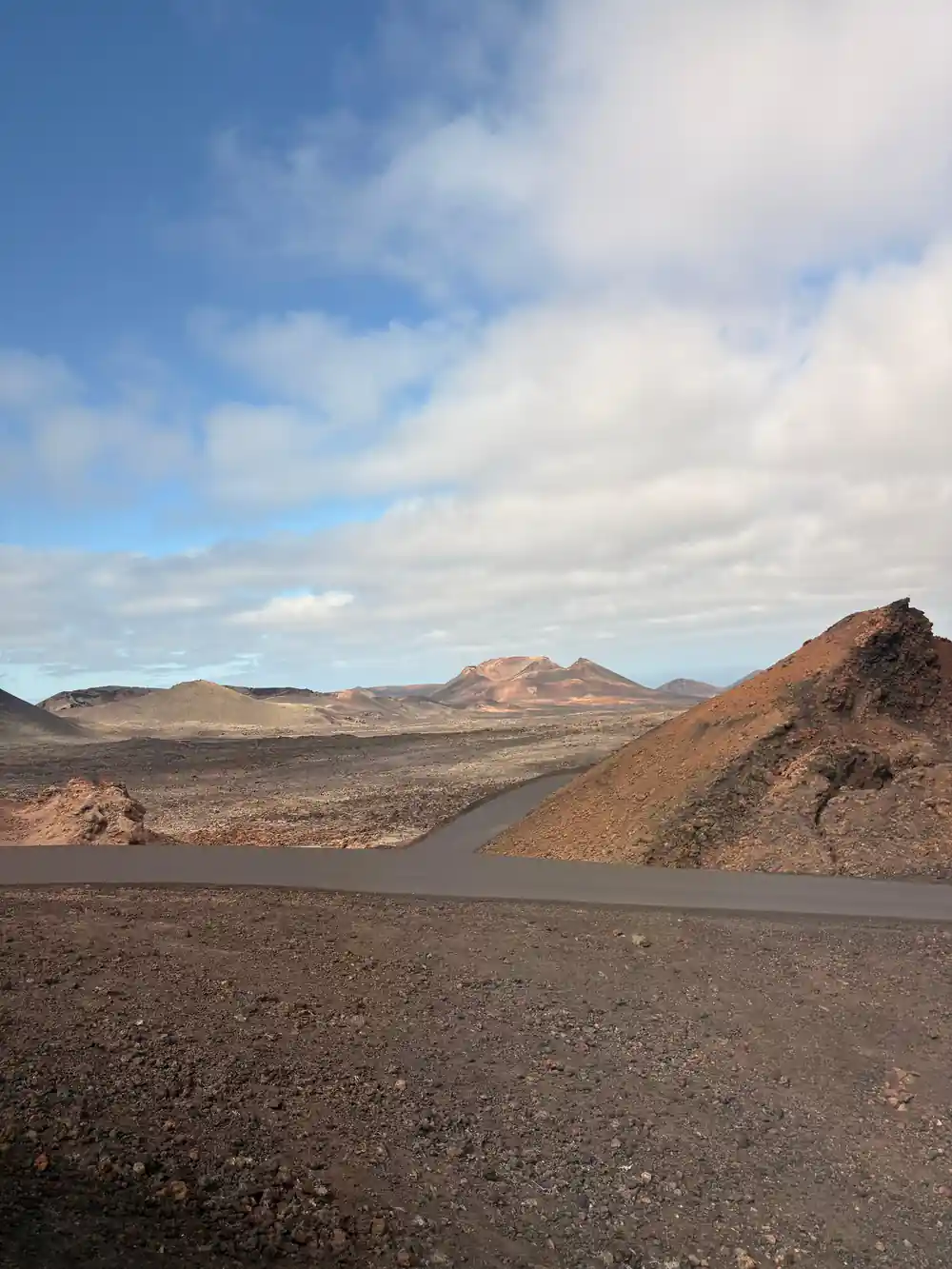
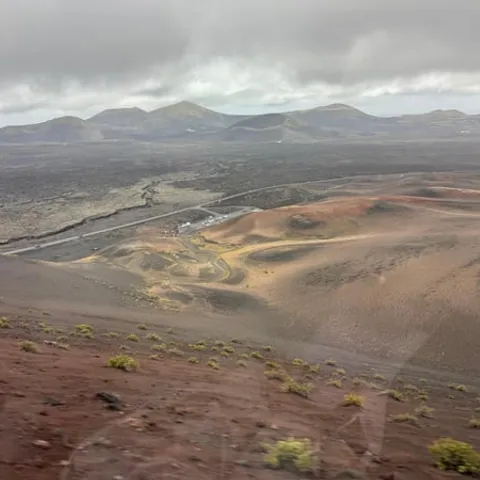
The coach pulls off the road onto a shelf of pale rock, and everyone steps down into the wind. This is Islote de Hilario, a small island of older ground ringed by darker lava, and it is the place where the heat under Lanzarote is put on show. Around you the park runs away in every direction, about 51 square kilometres (20 square miles) of bare volcanic ground with almost nothing growing on it.[13]
The demonstrations happen in a small roped area beside the parking. A ranger arrives with a bundle of dry brushwood and a container of water, says a few words in several languages, and then works through a routine that has been repeated here for a very long time. It takes only a few minutes. Then the next coach arrives and it starts all over again.
There is time to walk a short way and look at the lava, and the ground stays warm to the touch in places, so this is hot rock rather than a cooled museum piece. Stay on the marked path, keep an eye on children, and hold on to your hat, because the wind across the islet can lift one clean off your head.
The Geyser: Water Meets Superheated Rock
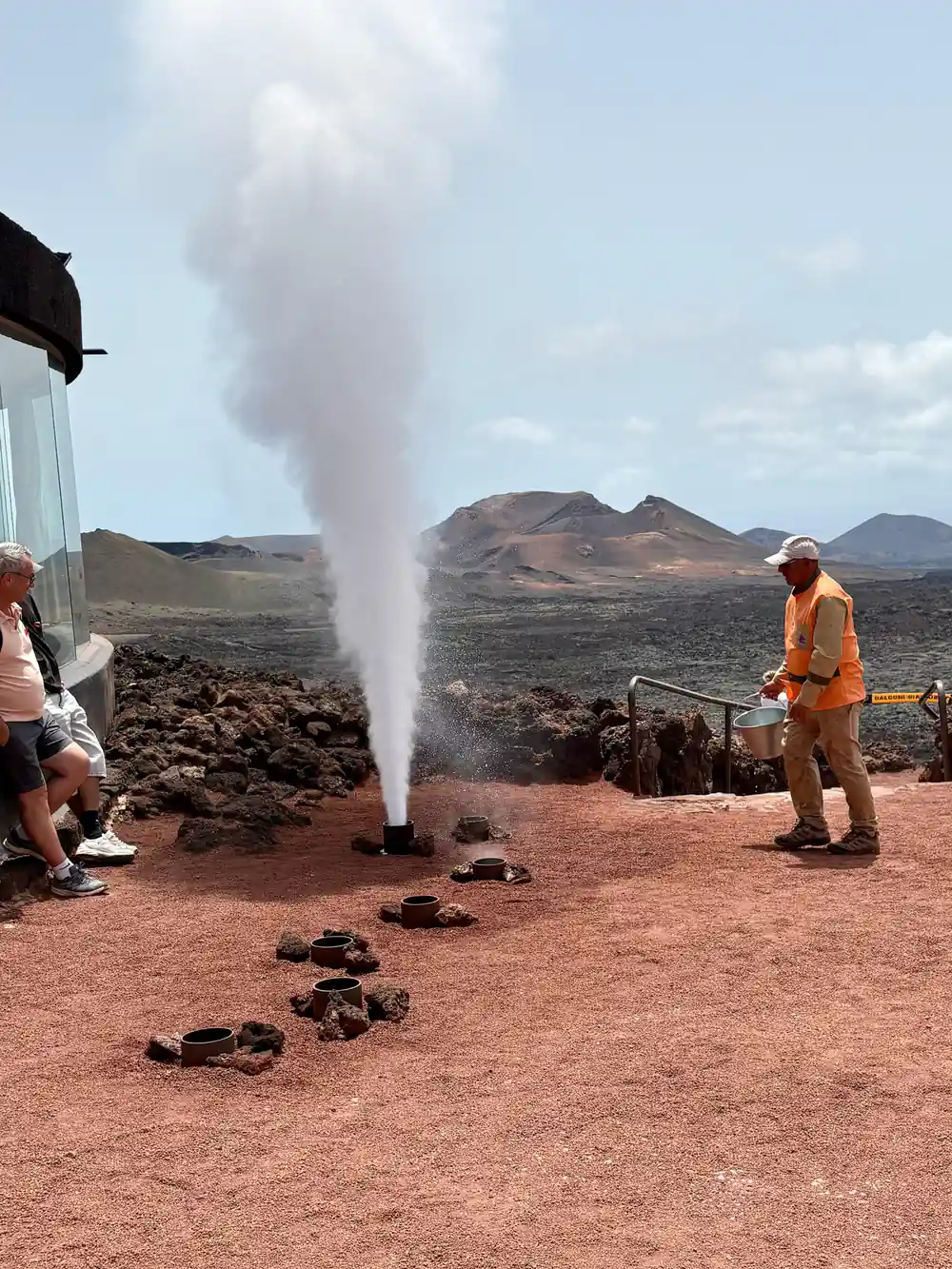
The first demonstration is the simplest. A ranger pours water into a borehole in the rock, steps back, and a column of steam shoots out of the ground a moment later. There is no flame and no fuel, only water meeting stone that is far hotter than boiling point. At Islote de Hilario the surface temperatures reach around 250 ºC, and 13 m down they can reach more than 600 ºC.[1]
The show depends on the wind. Stand upwind and you get a warm face full of vapour; stand to the side and you watch the column rise against black lava. Photographs come out best if you keep the horizon low in the frame and let the steam fill the top of it.
Rangers run the water demonstration several times through the day, so there is no single performance you have to catch. If the first one is crowded, wait for the crowd to drift back towards the coaches and watch the next one instead. The effect is exactly the same, and you will see far more of it.
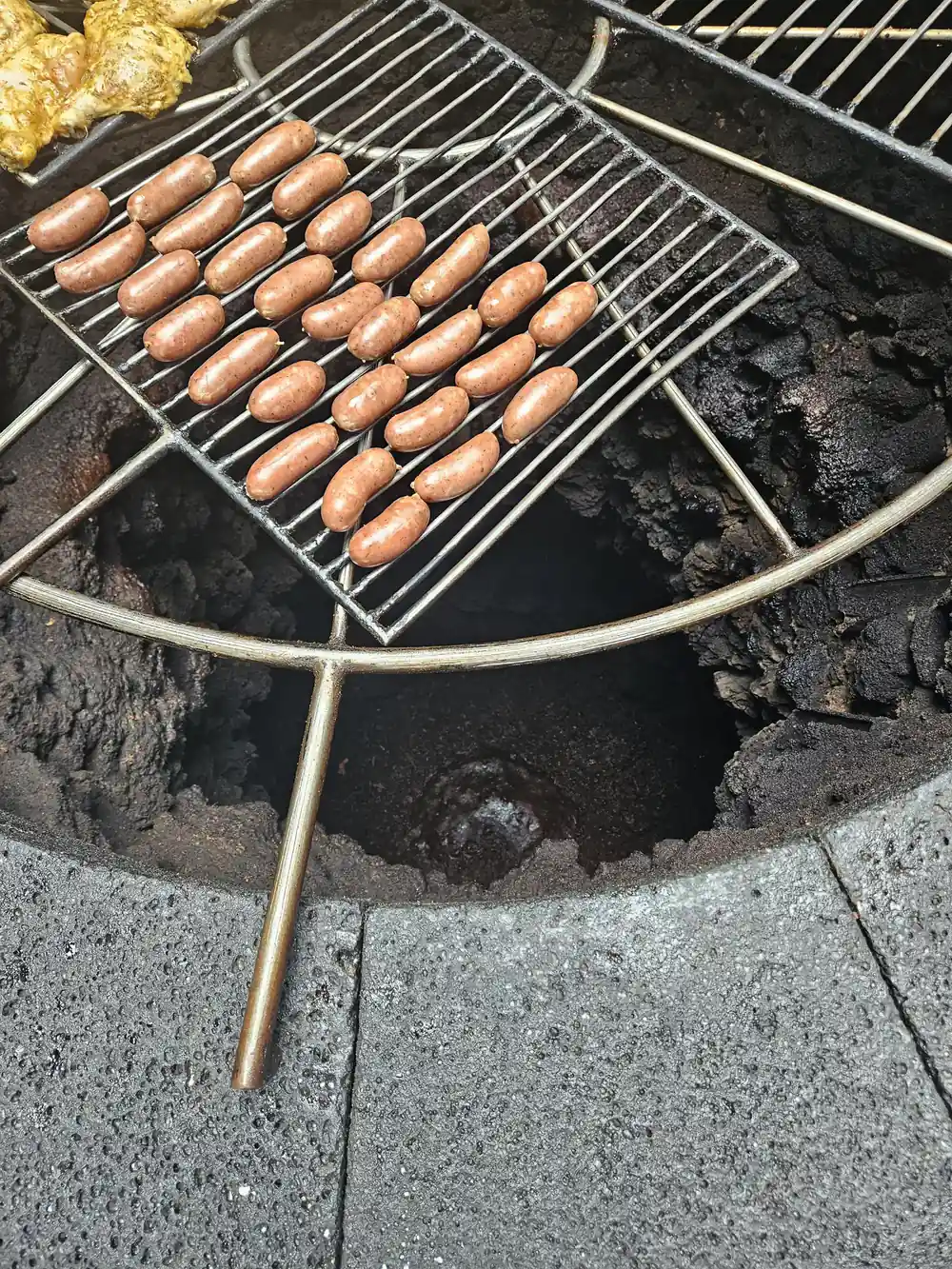
Steam, hot rock and a grill: the heat below Islote de Hilario is put to work.
The Brushwood Fire: Ignition from Below
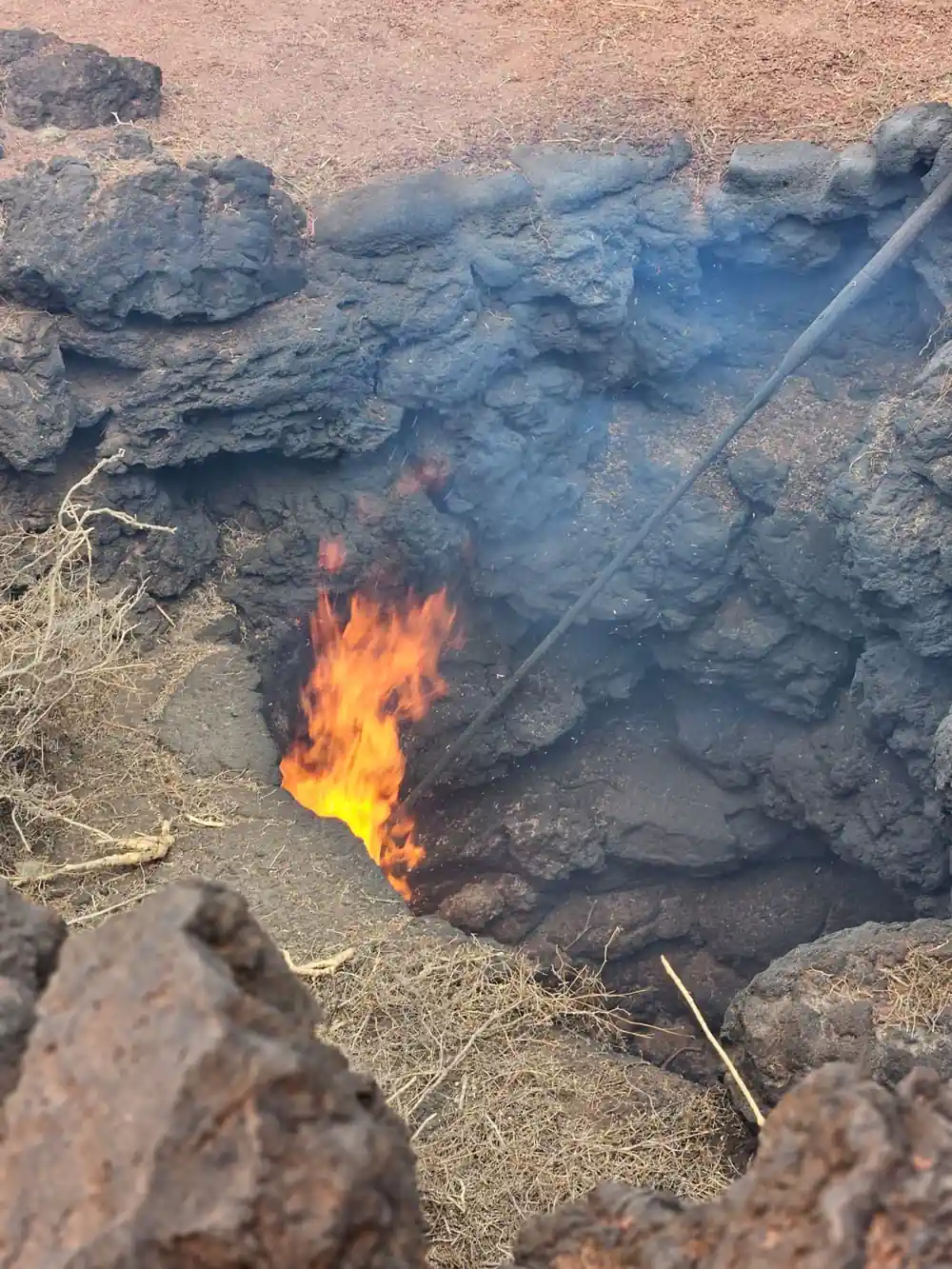
The second demonstration makes people laugh out loud the first time they see it. Dry brushwood is dropped into a shallow pit, one of the small Timanfaya National Park holes that visitors always ask about, and within seconds it is alight. Nobody strikes a match, and the wood catches anyway.
The flame is bright and quick, closer to a campfire catching than to a fire being lit. The ranger lets it burn for a short while and then the group moves on. The pit is shallow and open, so once the wood has burned down you can see the glow of the rock at the bottom, which is a good reminder of what is holding the heat.
Guides often point out that the same heat is what visitors meet later at the restaurant, where it is put to work instead of being watched. Stay behind the rope, keep scarves and bags close, and do not reach out to touch the ground beyond the barrier, however cool it looks. The heat also shapes the way a visit works, because visitors see the lava from the coach or from a marked viewpoint, and the demonstrations are staged in a small area where everyone can watch without walking far.
The El Diablo Grill: Cooking Over a Lava Pit
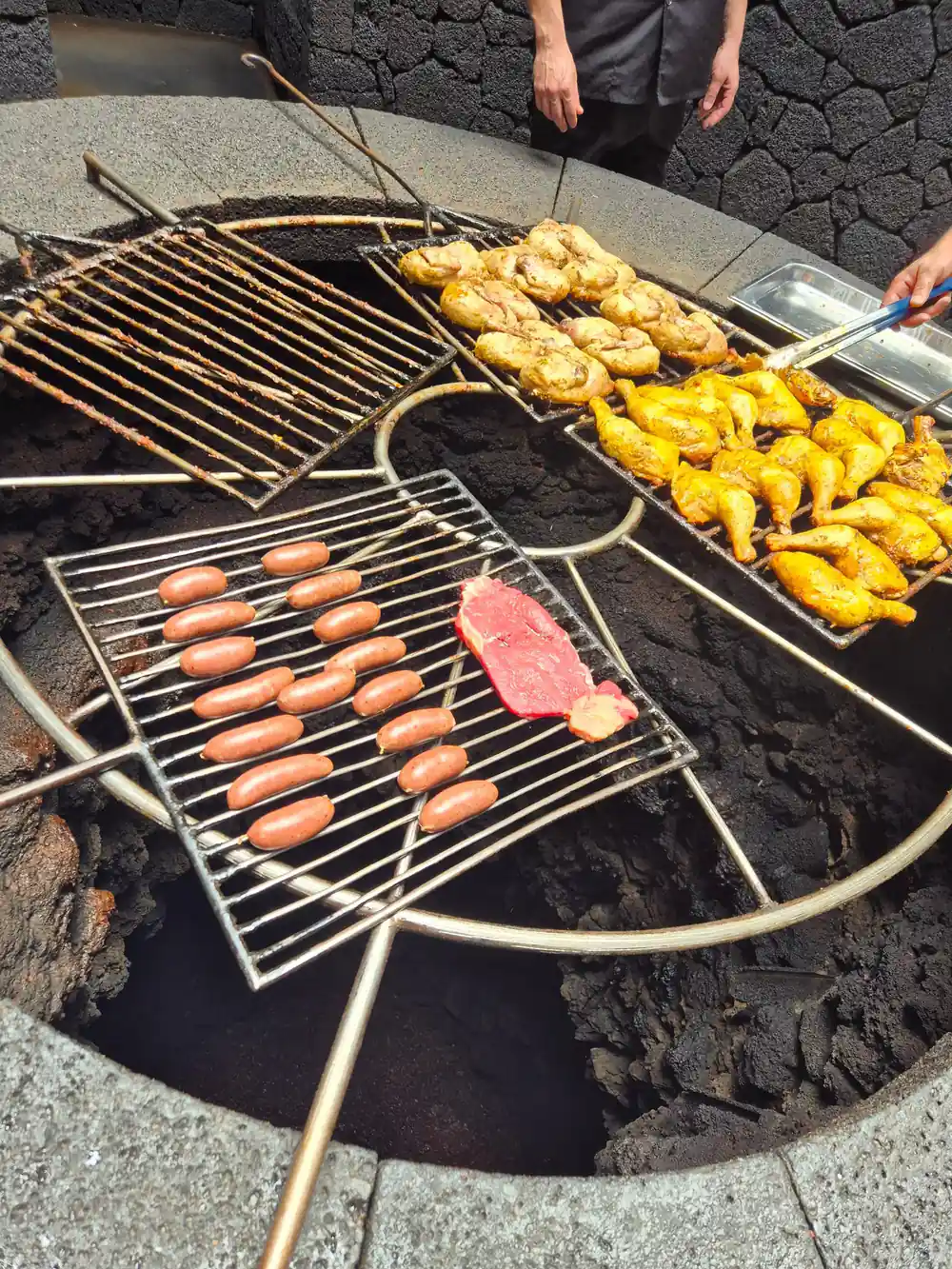
El Diablo, the Timanfaya National Park restaurant, stands at the edge of the islet with wide windows looking over the lava. Its grill is the part people remember. It uses natural heat from the subsoil, where temperatures exceed 600 °C just 15 meters below the surface, and meat and vegetables are cooked without fire or electricity, directly on a grill placed over an open cavity in the rock.[2]
Tables by the glass have the best view, and the room fills quickly whenever two or three coaches arrive together. If you are on a tour with a fixed departure time, order simply and eat without lingering. If you are driving yourself, this is a natural place to sit out the busiest part of the middle of the day.
There is a barbecue option as well. One listing pairs a visit to the park with a barbecue dinner, from US$149, and the duration is 4 hours.[14] If a Timanfaya National Park BBQ is what you are after rather than a table at El Diablo, that is the one to look at.
from US$102
The full-day tour runs 9 hours and covers Timanfaya National Park, Cueva de los Verdes and Jameos del Agua, from US$102.[4]
Three Centuries of Retained Heat: The Great Eruptions
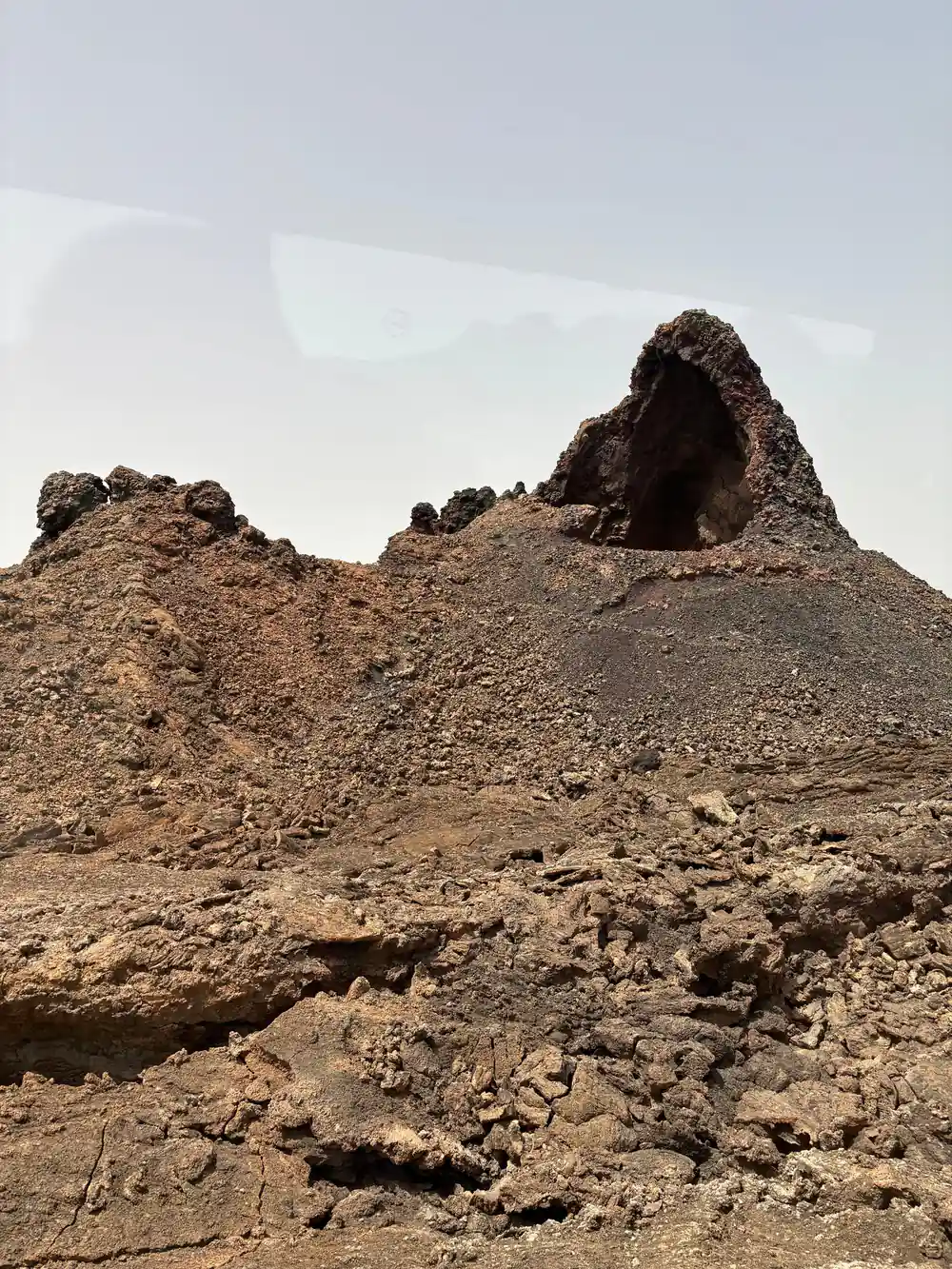
The lava you are looking at is not ancient. It came out of the ground during the 1730-1736 eruptive period, when the people of Lanzarote lived through years of eruptions. The Termesana Route is the way to get closer to that story: it lets visitors come into close contact with the volcano and with the culture of Lanzarote's inhabitants during the 1730-1736 eruptive period.[15]
Timanfaya was declared a National Park by a decree of August 9, 1974, published in the Official State Gazette on September 17, 1974.[16] The visitor centre at Mancha Blanca explains what happened here, with an exhibition and an audiovisual programme offering a complete overview of the park in several languages, and access to it is free.[9]
Film crews have long used this landscape as a stand-in for other worlds: several films inspired by other planets have been filmed in Timanfaya, including Enemy Mine, Krull, Mission Stardust, Stranded and Operation Ganymed.[17] Standing on the islet, with black rock in every direction and no green in sight, it is easy to see what drew them.
Magma or Stored Heat: Understanding the Source
What heats the islet is not a lake of molten rock sitting a few metres under your shoes. The heat is held in the rock itself, in deep layers that were buried by the eruptions and have never fully cooled. Water poured into a borehole finds stone that is hotter than the water can bear, and it flashes into steam almost at once.
Timanfaya is not a volcano you climb for a crater view. There is no smoking cone to photograph and no summit trail, so the interest is all in the ground beneath your feet and in the way the park turns that stored heat into something you can watch, and later eat.
If you want the science before the show, start at the visitor centre in Mancha Blanca, which is open Monday to Sunday from 9:00 to 16:00.[8] It makes a calm first stop before the wind and the crowds at the islet. A few centimetres below the surface the rock is hot enough to burn, and small islands of older ground like this one are where that heat comes closest to the open air, which makes Islote de Hilario an easy place to stage a demonstration.
Hilario the Hermit and Planning Your Visit
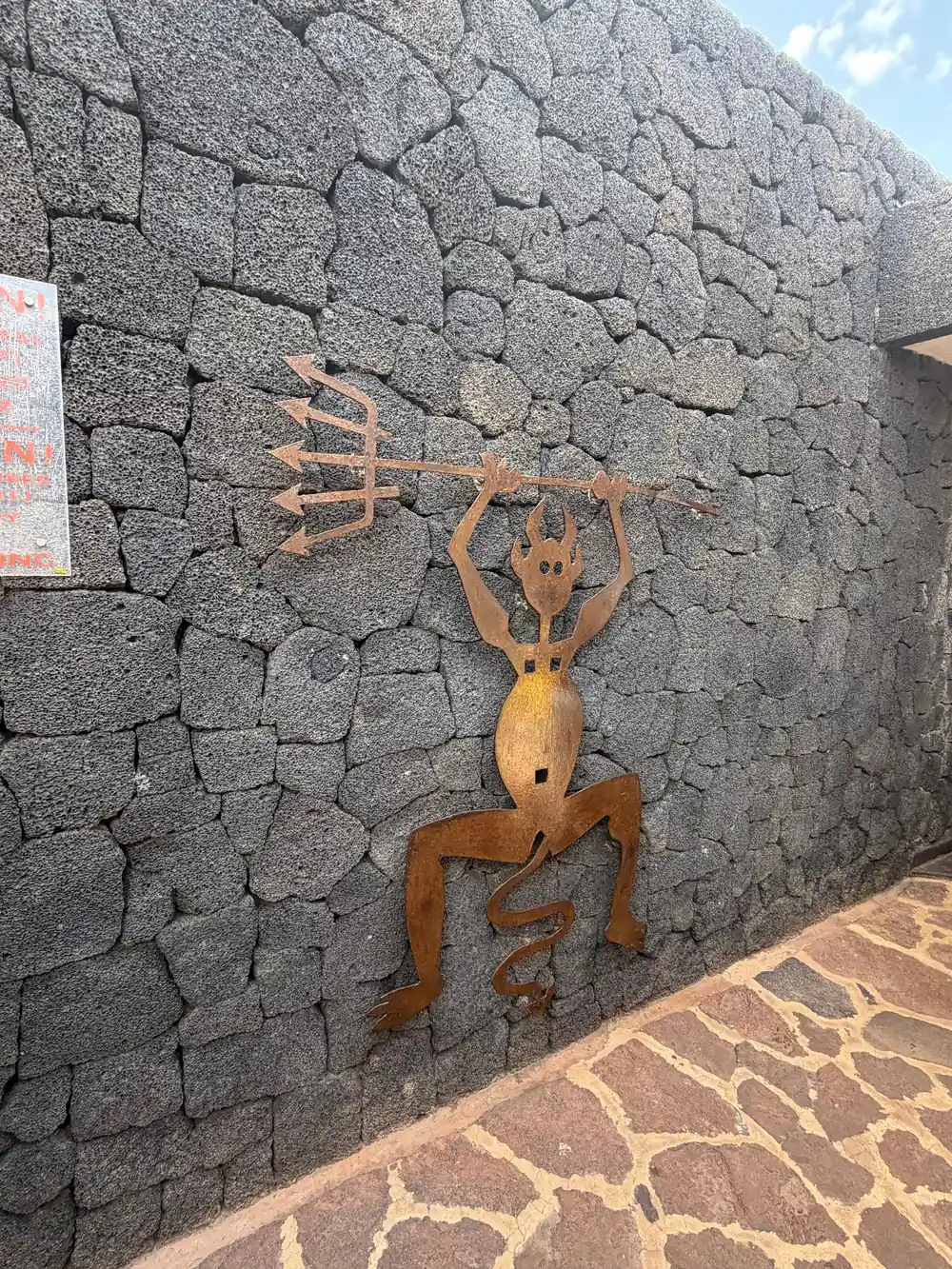
The islet takes its name from Hilario, a hermit who made his home among these lavas and whose name stayed on the small patch of old rock where the demonstrations now happen. The restaurant borrowed a different idea for its name, El Diablo, and the whole stop has the feel of a place that people have been visiting for a long time. Tickets for independent entry to Montañas del Fuego can only be purchased online and for a specific time slot.[3] The standard adult entrance ticket costs 30.00 EUR.[7] If you are on a coach tour with pickup, the day is arranged around you and the timing is handled for you.
Puerto del Carmen and Timanfaya National Park are about 22 km apart directly, with a road distance of about 23.5 km.[11] Line 60 passes through Yaiza on its route between Arrecife and Playa Blanca.[18] The Route of the Volcanoes has adapted coaches.[10] Whichever way you arrive, the last stretch of road crosses bare lava with nowhere to stop for shade or water, so bring both.
The camel ride at the park is a slower way to look at the lava, and it lasts approximately 20 minutes.[12] After the islet, the usual next stop is one of the caves, and the wind that met you here is often the thing people remember.
Heat below the ground at Timanfaya
Temperatures recorded at Islote de Hilario and below the El Diablo grill.[1][2]
From-prices for Timanfaya tours in US dollars
From-prices in US dollars for these tour listings.[4][5][6][14]
When to book and what to expect
Plan around the heat show
Book your park entry
Independent entry to Montañas del Fuego is online only, for a specific time slot.[3] Standard adult ticket costs 30.00 EUR.[7]
Ride the volcano route
The Route of the Volcanoes has adapted coaches.[10] Keep your camera ready for the coach loop across the bare lava.
Watch the water demo
Stay upwind of the steam and keep behind the rope at the borehole and at the brushwood pit.
Look beyond the pit
Walk to the viewpoint at the islet while you are there. The lava around it shows what the eruptions left behind, and the coach route crosses the same ground.
Eat at El Diablo
El Diablo Restaurant cooks on a grill over an open cavity in the rock, using heat from below.[2] Book ahead at busy times.
Book the full-day tour that stops at Islote de Hilario and the caves
from US$103Reserve now & pay later